.png)
Credit Card vs. Debit Card — Which Should You Actually Be Using?
Most Indians default to debit. Most financially sophisticated Indians default to credit. Here is why — and the discipline required.
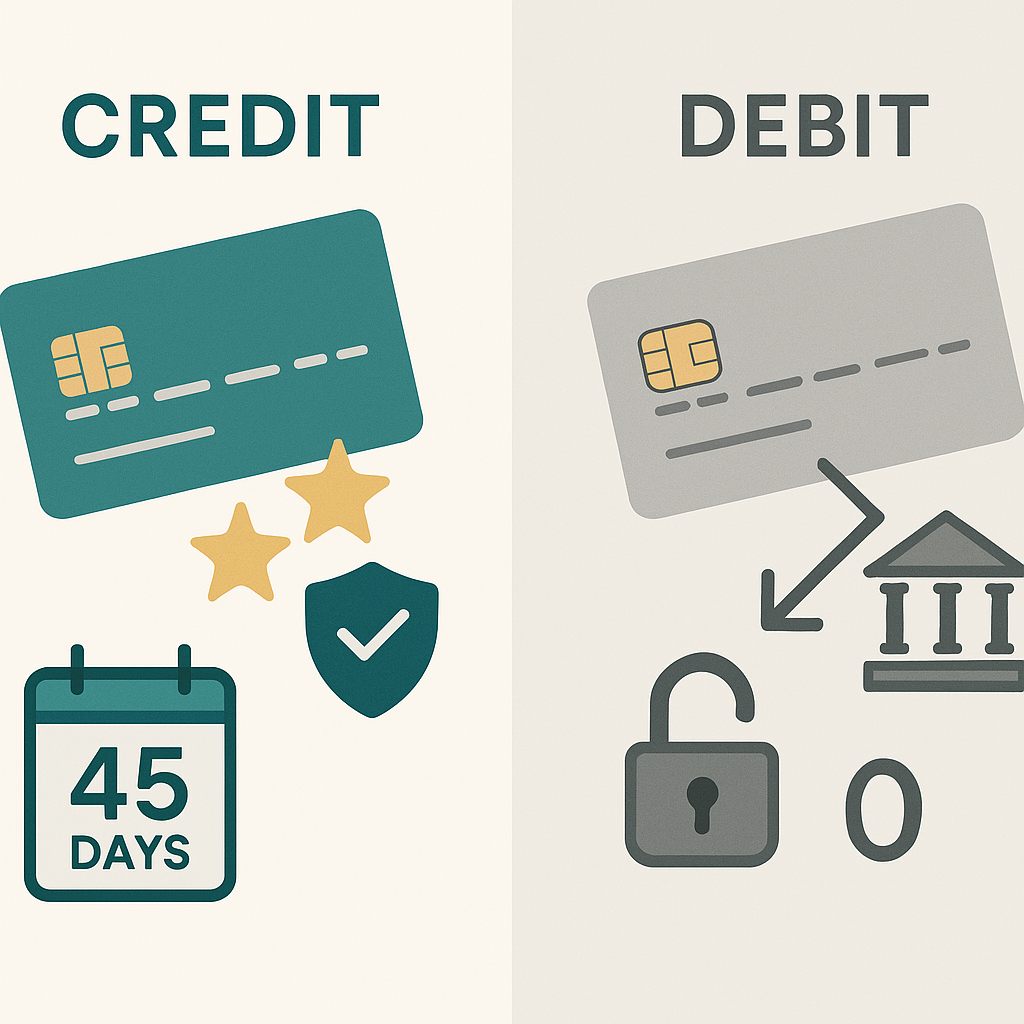
The instinctive answer for many Indians is: debit card is safer. You spend only what you have. No debt, no risk. This reasoning is not wrong — but it misses the significant advantages that a responsibly used credit card provides. Let us compare both honestly.
| Debit Card | Credit Card |
|---|---|
| Spends your own money immediately | Spends the bank's money — you repay later |
| No credit score impact | Builds credit history when used well |
| No rewards or cashback typically | Rewards, cashback, air miles, lounge access |
| No consumer protection for fraud | Strong fraud protection — zero liability |
| No interest cost if used correctly | No interest cost if paid in full each month |
| No credit building | Builds CIBIL score with responsible use |
The case for using a credit card — responsibly
When used correctly — spending within your means and paying the full outstanding balance before the due date — a credit card costs you nothing in interest. You get up to 45 days of free float on every purchase, plus rewards, cashback, and consumer protection. Your CIBIL score builds. Your fraud exposure is protected.
A debit card transaction fraud is settled from your own account — immediately, permanently, with limited recourse. A credit card transaction fraud is settled from the bank's money — with strong regulatory protection, the right to dispute, and zero liability if reported promptly. In India, credit card fraud protection is significantly more robust than debit card protection. This alone is a reason to prefer credit cards for online transactions.
The cardinal rule — and why most people fail it
Pay the full outstanding balance every month, before the due date. Not the minimum due — the full amount. The minimum due is designed to keep you in perpetual debt, paying 36–42% annual interest on the rolling balance. If you cannot pay the full amount — you cannot afford the purchase. This is the rule. Break it and a credit card becomes one of the most expensive financial products available.
When a debit card is still better
- When you have demonstrated inability to manage credit card spending within income.
- When the discipline to pay in full is genuinely not in place.
- For cash withdrawals — credit card cash advances are very expensive.
A credit card in the hands of a disciplined payer is a powerful, free financial tool. In the hands of an undisciplined payer, it is an expensive debt trap. The card is neutral. The behaviour determines the outcome.
Have a question about your finances?
FinAxis helps individuals and businesses across India with loans, working capital, wealth & insurance.
Talk to an expert