.png)
Credit Score
7 Things That Silently Damage Your Credit Score — Without You Realising
Your score is not just about missed EMIs. These less-obvious habits are damaging it right now.
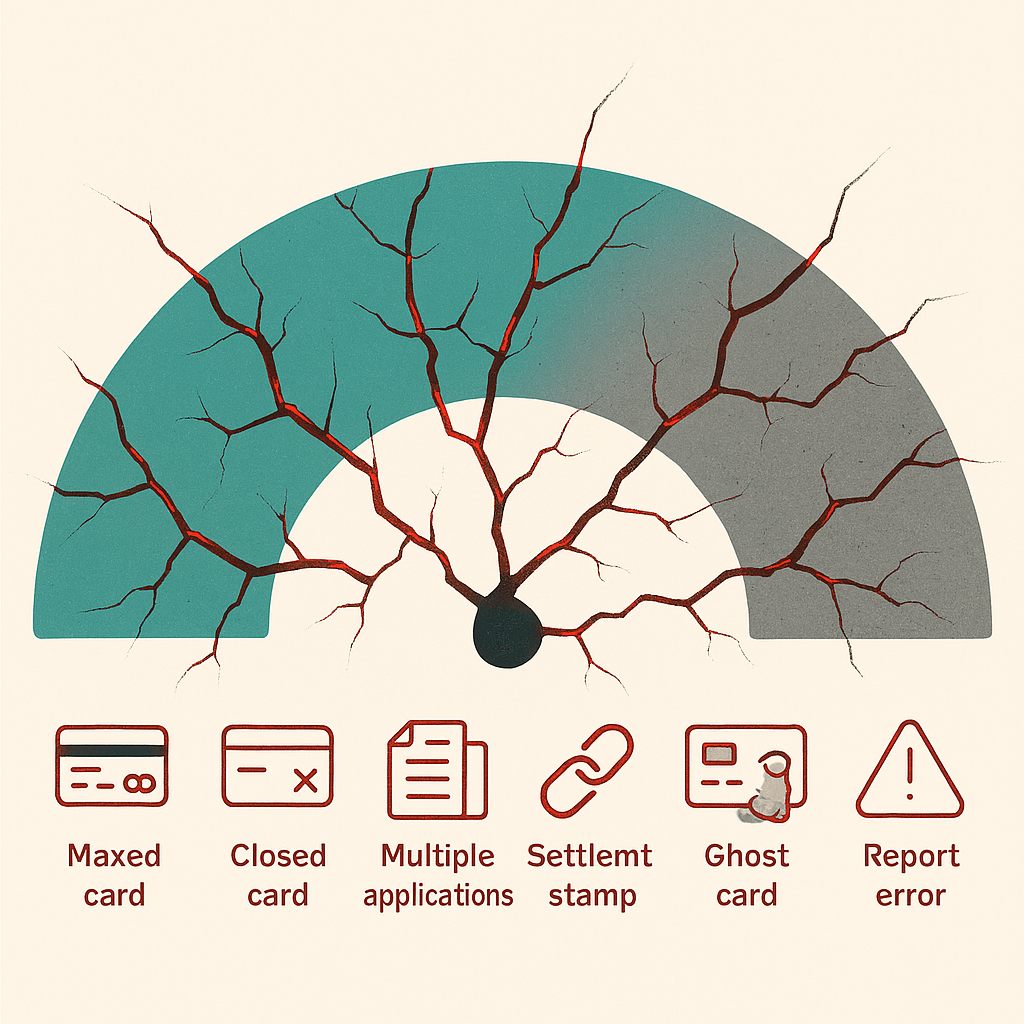
Most people know that missing a loan EMI is bad for their credit score. What they do not know are the quieter, less obvious behaviours that chip away at the score over months — often without a single missed payment.
01
High credit card utilisation Using more than 30–35% of your credit card limit consistently — even if you pay in full each month — signals to credit bureaus that you are heavily dependent on credit. A ₹1 lakh limit card with a ₹70,000 regular balance shows 70% utilisation. Even if perfectly paid, this hurts your score. Solution: pay mid-cycle to reduce reported balance, or request a higher limit.
02
Closing old credit cards An old credit card, even one you never use, has a long positive history. Closing it reduces your total credit history length and potentially increases your utilisation ratio. Keep old cards active — even with a small annual transaction to prevent the bank from closing them.
03
Multiple loan applications in a short period Every lender inquiry is a hard pull on your report. Applying to 5 banks for a loan in one month generates 5 hard inquiries. Bureaus interpret this as financial stress — you are borrowing from everyone simultaneously. Use a single advisor or aggregator to check eligibility without triggering hard pulls.
04
Being a guarantor on a defaulted loan If someone whose loan you guaranteed defaults — their default appears on your credit report too. You become partially responsible. Check periodically if any loans you have guaranteed are being repaid.
05
Settling credit card debt for less than owed If you negotiate with a bank to settle a credit card outstanding for ₹60,000 when you owe ₹80,000, the account is marked 'Settled' — not 'Closed.' Settled is a negative flag that persists for 7 years. Pay in full whenever possible.
06
No credit history at all A person with zero borrowing history has no score — or a very low one. Lenders cannot assess risk without history. Paradoxically, no credit history can cause a loan rejection just as surely as bad credit history. Build credit deliberately with a small credit card or a secured card.
07
Ignoring errors on your report Wrong defaults, outdated information, accounts that were closed but still show as open — these errors are more common than people realise and can suppress your score by 50–100 points. Annual report checks catch and correct these.
THE BOTTOM LINE
Credit score management is not just about paying on time. It is about managing utilisation, protecting your history, being selective about applications, and reviewing your report for errors. These seven habits, corrected, can meaningfully improve a score within 6–12 months.
Have a question about your finances?
FinAxis helps individuals and businesses across India with loans, working capital, wealth & insurance.
Talk to an expert